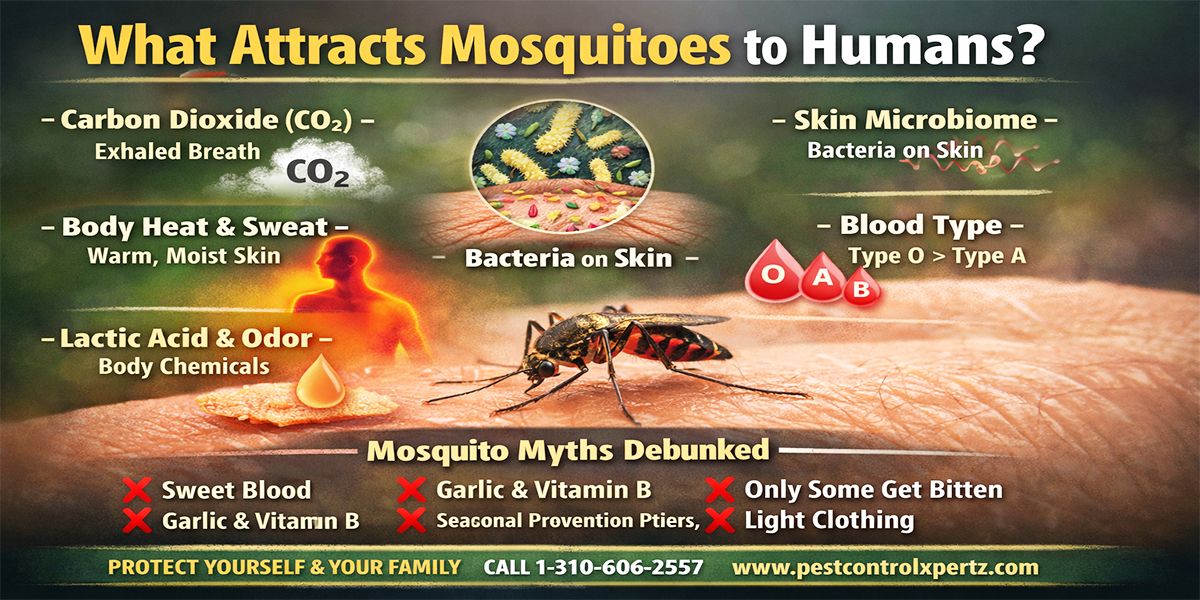
If you feel like you’re a magnet for mosquito bites, you’re not imagining things. These tiny pests are surprisingly selective in who they target and there’s real science behind their preferences.
In this post, we’ll explore what attracts mosquitoes to humans, the biological cues they follow, and debunk some common myths. With the right knowledge, you can take smarter steps to protect yourself and your family from mosquito bites.
What Are Mosquitoes Really Looking For?
Mosquitoes may be annoying, but their behavior is driven by survival. Specifically female mosquitoes need blood to develop their eggs. Over time they’ve evolved into highly efficient hunters.
They use a combination of:
-
Smell
-
Heat detection
-
Visual cues
-
Chemical sensing
Let’s break down exactly what draws mosquitoes to you.
1. Carbon Dioxide (CO₂) – The First Clue in Their Hunt
One of the primary attractants for mosquitoes is carbon dioxide (CO₂) — the gas we exhale when we breathe.
Mosquitoes can detect CO₂ from up to 100 feet away. It acts as a homing signal that tells them a living host is nearby.
The more CO₂ you produce, the more attractive you become.
Who’s at Higher Risk?
-
People exercising outdoors
-
Adults (larger bodies emit more CO₂ than children)
-
Pregnant women (due to increased metabolic activity)
If you’re jogging at dusk, you’re essentially sending out a mosquito invitation.
2. Body Heat and Moisture – A Warm, Welcoming Signal
Once mosquitoes get closer body heat becomes a key factor. They use specialized thermal sensors to detect warmth, helping them find exposed skin and blood vessels.
Sweat makes things even more appealing.
Moisture:
-
Enhances scent signals
-
Conducts heat more efficiently
-
Creates ideal landing spots
Common Target Areas:
-
Ankles
-
Wrists
-
Neck
-
Armpits
Warm, moist areas are prime feeding zones.
3. Lactic Acid and Body Odor – Chemical Signals That Matter
When you sweat, your body releases:
-
Lactic acid
-
Ammonia
-
Uric acid
-
Other organic compounds
Lactic acid is one of the strongest mosquito attractants.
Factors that increase lactic acid output:
-
Genetics
-
High physical activity
-
Higher body temperature
-
Certain diets
Your unique body chemistry plays a major role in how attractive you are to mosquitoes.
4. Skin Microbiome – Your Invisible Signature
Your skin hosts billions of bacteria that create your personal scent profile.
Research suggests it’s not just the amount of bacteria but the type and diversity that determines mosquito attraction.
Studies have shown:
-
People with less diverse skin bacteria may be bitten more often.
-
Certain bacterial combinations produce odors mosquitoes find irresistible.
In short: your skin microbiome is like a scent fingerprint.
5. Blood Type – Does It Really Matter?
A 2004 study found mosquitoes landed on individuals with Type O blood nearly twice as often as those with Type A.
However:
-
Mosquitoes don’t know your blood type before biting.
-
Attraction likely comes from skin-secreted chemicals linked to blood type.
-
Blood type alone does not determine bite frequency.
It’s just one factor among many.
Debunking Common Mosquito Myths
Myth #1: Mosquitoes Are Attracted to “Sweet Blood”
There’s no scientific evidence supporting this claim.
Mosquitoes don’t detect sweetness. They respond to:
-
CO₂
-
Heat
-
Body odor
-
Chemical signals
Sugar consumption does not make you more attractive to mosquitoes.
Myth #2: Garlic, Bananas, or Vitamin B Repel Mosquitoes
Despite popular belief, studies show no reliable proof that eating garlic, bananas or taking Vitamin B supplements repels mosquitoes.
While these foods may slightly alter your scent, they do not provide meaningful protection.
Myth #3: Only Certain People Get Bitten
Everyone gets bitten.
Some people:
-
React more strongly
-
Develop larger welts
-
Notice itching more
Others have milder reactions and assume they weren’t bitten at all.
Myth #4: Mosquitoes Prefer Light Clothing
Actually, mosquitoes are more attracted to dark colors such as:
-
Black
-
Navy
-
Red
Darker clothing stands out visually against the horizon, especially during dusk when mosquitoes are most active.
How to Reduce Mosquito Attraction?
Now that you understand what attracts mosquitoes here are practical steps to lower your risk:
-
Wear light-colored clothing
-
Avoid peak mosquito hours (dawn & dusk)
-
Use EPA-approved repellents
-
Shower after heavy sweating
-
Remove standing water around your home
-
Install outdoor fans (mosquitoes are weak fliers)
Need Professional Mosquito Control?
While prevention helps, heavy infestations require professional treatment.
At Pest Control Xpertz we provide professional mosquito control treatments designed to protect your family and pets all season long. Serving Tennessee for over 20 years we know how to keep your outdoor spaces safe, comfortable and bite-free.
Our services include:
-
Yard barrier treatments
-
Mosquito breeding site elimination
-
Seasonal prevention plans
-
Family- and pet-safe solutions
Ready to Enjoy a Mosquito-Free Yard?
Contact Pest Control Xpertz today to schedule your consultation and reclaim your outdoor space.
Visit: https://www.pestcontrolxpertz.com
Or call now: 1-310-606-2557
